


Table of Contents
Lot tracking identifies a batch of product made together under one lot or batch number, usually with a shared expiration date, and records which lot shipped in each order. Serialization gives every individual unit its own unique serial number, paired with the product’s GTIN, and records where each specific unit went.
In a 3PL warehouse, lot tracking means capturing lot and expiration data at receiving and keeping it attached to inventory through picking and shipping, so a recall or quality hold can be scoped to specific lots and specific customers.
Serialization means scanning each unit’s unique code at several points, typically receiving, picking and packing, so the brand can trace one bottle or compact from dock to doorstep. Most beauty brands, including nearly all haircare and mass skincare lines, need lot tracking and first-expired, first-out (FEFO) picking, not serialization.
Item-level serialization earns its added cost and complexity for premium and luxury brands managing diversion and counterfeits, for products where authenticity verification is part of the customer promise, and when a retail partner requires serialized units.
What Is Lot Tracking?
A lot, or batch, is a quantity of product manufactured under the same conditions, usually in a single production run. Every unit in the lot shares a lot number, and for products with a shelf life, an expiration or manufacture date. Lot tracking is the practice of preserving that identity through the supply chain so the brand always knows which lots are on hand, where they are stored and which customers received them.
For beauty brands, lot tracking supports three jobs. It enables FEFO picking, so units with the nearest expiration date ship first. It supports quality holds, so a lot under investigation can be blocked from shipping in minutes. And it supports recalls, so the brand can identify exactly which orders contained an affected lot rather than pulling every unit of the SKU.
What Is Serialization?
Serialization assigns a unique serial number to each individual unit. Combined with the product’s GTIN, that serial number identifies one specific item among all others of the same product. The GS1 guideline for 2D barcodes at retail notes that a serial number must be used with a GTIN to uniquely identify a specific trade item instance, and that a 2D barcode can carry the serial number alongside batch or lot number and expiration date.
Serialization in beauty is a brand protection and channel control tool, not a regulatory mandate. It is also distinct from pharmaceutical serialization. The Drug Supply Chain Security Act requires certain prescription drugs to be identified and traced at the package level, with its own verification and data-exchange rules. Cosmetics and ordinary OTC beauty products sit outside that framework, so beauty brands choose serialization for business reasons.
What is the difference between lot tracking and serialization?
Lot tracking follows a group of units made together, identified by one lot number and usually one expiration date. Serialization follows each individual unit, identified by its own unique serial number. Lot tracking tells a brand which batch went to which order. Serialization tells a brand exactly which unit went to which order, which is what anti-diversion and authenticity programs require.
How Each Works in the Warehouse
Lot capture at receiving
Lot tracking starts at the receiving dock. When inbound inventory arrives, the warehouse records the lot number and expiration date for each carton, pallet or unit, either by scanning a barcode that encodes the data or by keying it from the label and verifying it against the advance ship notice. The warehouse management system then stores each lot as a distinct inventory record, even when several lots of the same SKU sit in the same location.
From there, the system allocates inventory by expiration date. FEFO logic picks the nearest-dated lot first and holds back units that fall inside the brand’s minimum remaining shelf-life rule for a given customer or channel. At pack and ship, the outbound record captures which lot went into each order. That lot-to-order history is what a brand pulls when it needs to scope a recall, answer a retailer’s question or investigate a customer complaint.
Serialized scan events
Serialization adds a scan for every unit at every handoff. At receiving, each unit’s code is scanned and recorded against the inbound shipment. At picking and packing, the specific units placed in each order are scanned again, so the outbound record lists serial numbers rather than just quantities and lots. Kits and gift sets add another layer, because the system must record which serialized components were assembled into which finished kit. Returns repeat the process in reverse.
The data carrier is usually a GS1 2D barcode, either a GS1 DataMatrix or a QR code using GS1 Digital Link syntax. Both can encode the GTIN, lot, expiration date and serial number in one symbol. The U.S. retail industry’s Sunrise 2027 initiative is moving point-of-sale systems toward reading these 2D codes, with the goal that 2D barcodes can be scanned and processed at any retail POS by the end of 2027. That transition will make lot and expiration data easier to capture everywhere, but a 2D barcode is not the same as serialization. A product is serialized only when each unit carries a unique serial number and the supply chain actually scans and records it.
Recall Scope: Lots vs. Units
The practical difference between the two approaches is clearest during a recall. With lot tracking, the brand identifies the affected lots, finds the orders that contained them and notifies those customers, while units from unaffected lots keep shipping. With serialization, the brand can go one step further and identify the specific units involved, which matters most when a problem is limited to a subset of a lot or when the brand needs to prove that a unit in the market is or is not one of its own.
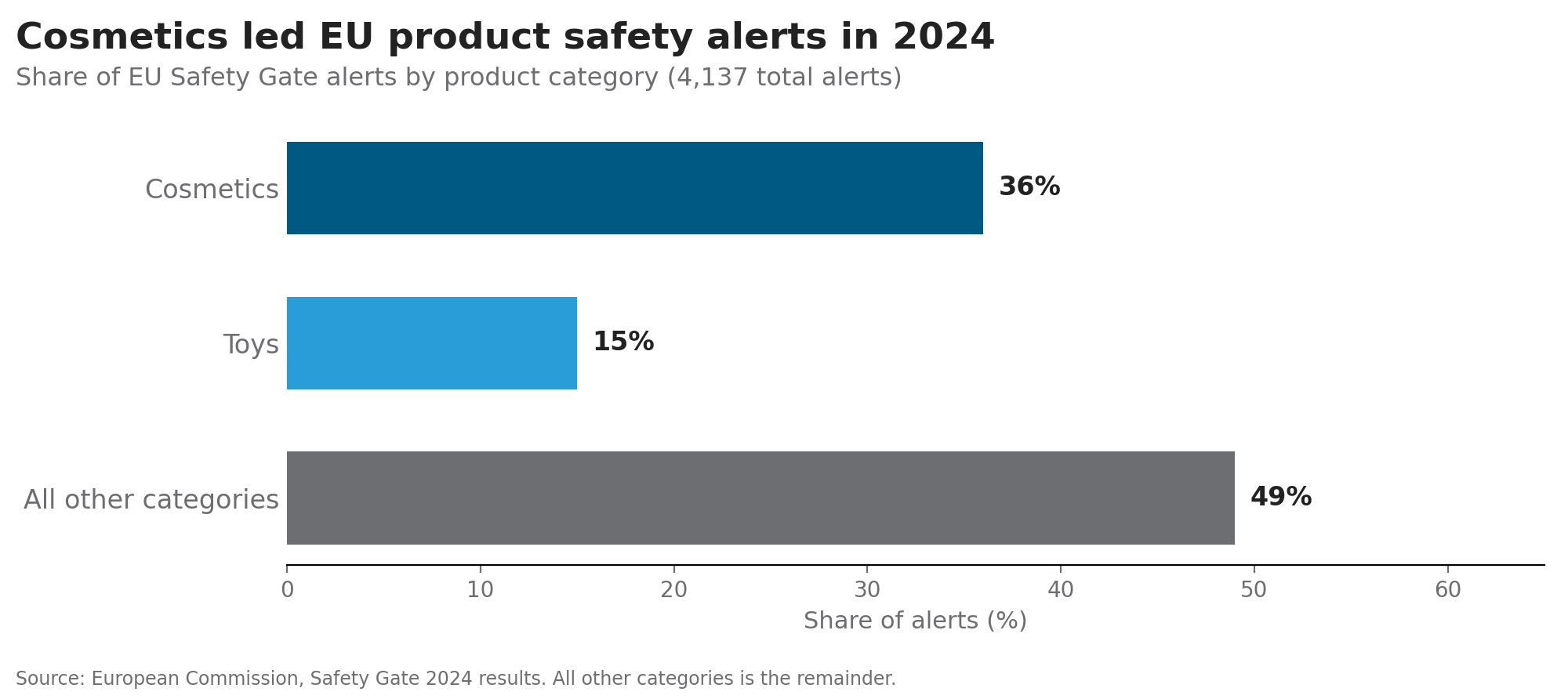
Recall and safety exposure in beauty is real. MoCRA gave FDA mandatory recall authority over cosmetics when a responsible person declines a voluntary recall of a product that poses a reasonable probability of serious harm. In the European Union, the Safety Gate rapid alert system recorded 4,137 alerts in 2024, and cosmetics were the most notified product category at 36%, ahead of toys at 15%.
For the large majority of beauty quality events, lot-level scope is enough. The units in a lot share a formula, a production run and a set of raw materials, which is usually where the problem originates.
When Beauty Brands Need Item-Level Serialization
Serialization makes sense when the risk a brand is managing lives at the unit level rather than the batch level. Counterfeiting and diversion are the most common examples. The OECD and EUIPO estimate that global trade in counterfeit goods reached USD 467 billion in 2021, about 2.3% of world imports, and their 2025 report ranks cosmetics as the sixth most frequently seized counterfeit category in the EU. Premium and luxury skincare, color cosmetics and fragrance brands are the most exposed because the price gap between genuine and fake product, or between authorized and gray-market channels, is largest.
Serialization helps in four situations. Anti-diversion programs use serial numbers to identify which authorized distributor or retailer a unit was originally shipped to when it turns up in an unauthorized channel. Authenticity programs let consumers, retailers or customer service teams verify that a unit is genuine. Retailer or marketplace requirements sometimes call for serialized units as part of a brand protection or prestige distribution agreement. And device-like beauty products, such as skincare tools with warranties or registrations, use serial numbers to manage service and returns.
When Lot Tracking Is Enough
For most beauty brands, lot tracking with FEFO covers every operational and regulatory need. Haircare, mass and masstige skincare, body care and most color cosmetics sold through DTC, marketplaces and mainstream retail fall into this group. Their quality risks are batch-level, their counterfeit exposure is modest relative to the cost of unit-level scanning, and their retail partners typically require accurate lot and expiration data, compliant GS1 case labels and routing guide compliance rather than serialized units.
Do haircare brands need serialization?
Usually not. Haircare products are typically produced and sold in large batches with modest unit prices and limited counterfeit exposure, so lot and expiration tracking with FEFO picking meets most operational, retail and recall needs. Serialization becomes worth considering only if a haircare brand runs a premium anti-diversion program or a retail partner specifically requires serialized units.
The Cost and Complexity Trade-off
Lot tracking adds modest work to a well-run warehouse. Lot and expiry are captured once per inbound carton or pallet, stored as inventory attributes and recorded at shipping. The main requirements are accurate labels from the manufacturer, disciplined receiving and a warehouse system that enforces FEFO without manual workarounds.
Serialization raises the effort at nearly every step. Packaging must carry a unique code on every unit, which usually means changes at the manufacturer or co-packer. The warehouse must scan each unit rather than each carton, which slows receiving and packing and requires more scanning hardware and training. Systems must store and exchange far more data, often with a separate brand protection or authentication platform. Kitting, returns and exception handling all become more complex. None of this makes serialization a bad investment for brands that need it; it means the decision should be driven by a specific diversion, authenticity or retailer requirement rather than adopted by default.
Lot Tracking vs. Serialization at a Glance
| Lot tracking | Item-level serialization | |
|---|---|---|
| What is identified | A batch of units made together | Each individual unit |
| Typical identifier | Lot or batch number plus expiration date | GTIN plus unique serial number |
| Common data carrier | Linear or 2D barcode on the unit, case or pallet label | GS1 DataMatrix or QR code with GS1 Digital Link on each unit |
| Warehouse scan points | Receiving and shipping, recorded per lot | Receiving, picking, packing and returns, recorded per unit |
| Recall scope | Specific lots and the orders that received them | Specific units, even within a lot |
| Main beauty use cases | Shelf life, FEFO, quality holds, recalls, retail compliance | Anti-diversion, authenticity, retailer brand protection, warranties |
| Who usually needs it | Nearly all beauty brands | Premium, luxury and high-counterfeit-risk brands |
| Operational complexity | Moderate | High |
How Cart.com Approaches Lot Tracking and FEFO
Cart.com focuses on the traceability most beauty brands need every day. Its fulfillment operations support lot and expiration date capture at receiving, FEFO allocation at pick and lot traceability from receipt through each outbound order, so brands can scope a quality hold or recall to specific lots and customers.
Cart.com also supports kitting for gift sets, samples, gift-with-purchase programs and subscriptions, retail-ready programs with EDI, GS1 and UCC-128 labeling and routing guide compliance, and returns inspection and quarantine, all alongside DTC and marketplace fulfillment. Brands that need item-level serialization should evaluate that requirement explicitly with any 3PL, including what is supported, at which sites and how it connects to their brand protection tools.
This post explains general concepts and is not legal advice; brands should confirm their specific requirements with regulatory counsel.
Frequently Asked Questions
Is serialization required for cosmetics in the U.S.?
No. U.S. law does not require item-level serialization for cosmetics. The Drug Supply Chain Security Act serialization rules apply to certain prescription drugs, not cosmetics. Beauty brands adopt serialization for brand protection, anti-diversion or retailer requirements.
What is a lot number on beauty products?
A lot number, sometimes called a batch code, identifies a group of units produced together in the same manufacturing run. It lets the brand and its partners trace those units through the supply chain, manage expiration dates and limit a recall or quality hold to the affected batch.
Can lot tracking help with a product recall?
Yes. When lot and expiration data is captured at receiving and recorded at shipping, a brand can identify exactly which orders received an affected lot, notify those customers and keep shipping unaffected lots. Without lot records, brands often have to recall every unit of a SKU.
What is a GS1 DataMatrix barcode?
A GS1 DataMatrix is a compact 2D barcode that can encode a product’s GTIN along with additional data such as batch or lot number, expiration date and serial number. It is one of the 2D symbols the retail industry is preparing to scan at point of sale as part of the move toward 2D barcodes by 2027.
Does a 2D barcode mean my products are serialized?
Not necessarily. A 2D barcode can carry lot and expiration data without a unique serial number. Products are serialized only when each unit carries its own serial number and the supply chain scans and records it at each handoff.
How does FEFO relate to lot tracking?
FEFO, or first-expired, first-out, depends on lot tracking. Once a warehouse knows the lot and expiration date of every unit, its system can automatically pick the nearest-dated lot first and hold back units that do not meet a minimum shelf-life rule.
Related Reading
What Beauty and Supplement Brands Actually Need from a 3PL: Lot Tracking, Serialization, HIPAA and SOC 2 Explained
The Complete Guide to Beauty and Cosmetics Fulfillment
Best 3PLs for Beauty and Cosmetics Fulfillment
Traceability protects your customers, your retail relationships and your brand. Cart.com helps beauty brands capture lot and expiration data at receiving, ship by FEFO and trace every lot to every order across DTC, marketplace and retail channels. See how Cart.com supports beauty and cosmetics brands, or talk to our team about building a fulfillment program around your traceability requirements.