

Table of Contents
If you're a supply chain or operations leader at a large apparel brand right now, you've almost certainly had some version of this conversation: should we be sourcing closer to home, or do we need to rethink how we distribute what we're already sourcing?
Both near-shoring and multi-node fulfillment are being presented as solutions to the same problem — tariff exposure, supply chain fragility, and rising landed costs. But they're not the same lever, they don't operate on the same timeline, and for most large apparel brands, choosing one to the exclusion of the other is a mistake.
Here's how to think clearly about both — and how to build a strategy that actually protects margin.
What near-shoring actually solves (and what it doesn't)
Near-shoring — shifting manufacturing to Mexico, Central America, or other Western Hemisphere countries — addresses the cost of importing goods. When the tariff on Chinese-made apparel climbs, goods manufactured in Mexico under USMCA face a fundamentally different duty structure. For brands with high China concentration, that difference can be measured in tens of millions of dollars annually.
The case for near-shoring is real. Shorter transit times, reduced duty exposure, lower inventory-in-transit carrying costs, and more predictable lead times all improve the economics of sourcing closer to the end customer. American Eagle's push to get China exposure below 10% and Gap's target of limiting any single country to 25% of sourcing reflect this logic at scale.
But near-shoring has significant constraints that make it a slow, expensive, and only partially effective solution:
Lead times to build near-shore capacity are measured in years, not months. Moving manufacturing to Mexico or Central America requires establishing supplier relationships, qualifying factories, auditing labor and environmental practices, and scaling production — none of which happens in a quarter.
Near-shoring doesn't solve the distribution problem. A garment manufactured in Guatemala still needs to get to a customer in Boston or Chicago in two days or fewer. Where it's manufactured has no bearing on whether your fulfillment network can deliver that promise efficiently.
Cost parity is rarely immediate. Near-shore manufacturing often costs more per unit than established Asian suppliers, at least initially. The duty savings may offset some or all of that premium — but until they do, margin pressure doesn't disappear, it just comes from a different place.
Near-shoring is a medium-to-long-term sourcing strategy. It's worth pursuing, but it cannot be your primary response to a tariff environment that is moving faster than supplier relationships can be rebuilt.
What multi-node fulfillment solves — and why it's the faster lever
Multi-node fulfillment is the practice of distributing inventory across multiple warehouse locations to place goods closer to end customers, reduce shipping zones, and maintain flexibility as demand patterns shift.
For large omnichannel apparel brands, a well-designed multi-node network does several things that near-shoring cannot.
It cuts per-order shipping cost immediately
Shipping zones are one of the most controllable costs in fulfillment. A brand fulfilling all orders from a single facility in, say, Nevada is shipping packages across 6–8 zones to reach East Coast customers. Move that inventory to a facility in Pennsylvania and those same orders ship from zone 1–2. The per-order cost difference can range from $1.50 to $4.00 depending on carrier and package weight — a meaningful number at scale.
When tariffs are squeezing landed costs, reducing per-order shipping spend is one of the fastest ways to offset margin pressure without touching pricing or sourcing.
It absorbs sourcing volatility without disrupting order flow
When a brand shifts from one sourcing country to another — or receives a large reshored inventory shipment that needs to enter the active fulfillment network quickly — a multi-node 3PL can absorb that inventory into the appropriate node based on where demand is, rather than forcing everything through a single warehouse that may not be geographically optimal.
This is not theoretical. When Cart.com helped multiple nine-figure apparel brands reshore millions of units of inventory within days, the ability to receive and process that inventory across a nationwide network of 17 facilities was what made a 10-day transition possible without order flow disruption.
It enables true omnichannel fulfillment
Large apparel brands rarely operate on a single channel. Most manage DTC ecommerce, wholesale distribution, retail replenishment, and marketplace orders simultaneously. Each of these channels has different fulfillment requirements: DTC needs speed and branded packaging; wholesale needs compliance with retailer routing guides; retail replenishment needs precise carton-level accuracy.
A multi-node network, backed by an order management system that routes each order to the optimal node based on channel requirements and inventory availability, is what makes omnichannel fulfillment operationally viable at scale — not just strategically appealing.
How to think about both strategies together
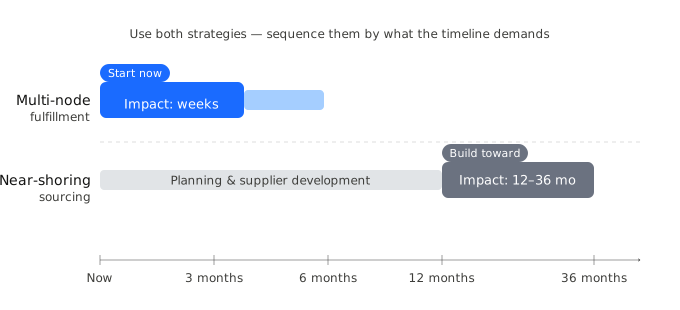
The mistake most brands make is framing near-shoring and multi-node fulfillment as competing choices. They're not. They operate on different timelines and address different parts of the margin equation.
| Near-shoring | Multi-node fulfillment | |
|---|---|---|
| What it addresses | Sourcing cost and duty exposure | Distribution cost and fulfillment flexibility |
| Timeline to impact | 12–36 months | Weeks to months |
| Capital intensity | High (supplier development, factory qualification) | Lower (3PL partnership, not infrastructure ownership) |
| Ongoing complexity | Supplier management, quality control, lead time variability | Node optimization, inventory allocation, WMS integration |
| Best for | Reducing structural tariff exposure | Responding to immediate margin pressure and building resilience |
The right approach for most large apparel brands in 2026 is to pursue both on appropriate timelines: build near-shore sourcing capacity over the next one to three years while immediately optimizing the fulfillment network to reduce per-order costs and increase flexibility.
That sequencing matters. Near-shoring takes time. The fulfillment network can be restructured now.
What the fulfillment side of this strategy requires
If multi-node fulfillment is the faster lever, the question becomes: what does your fulfillment infrastructure need to support it effectively?
A 3PL with a genuine national network. Not a single facility with a satellite location, but a true multi-node operation with warehouse capacity in the geography your customers are concentrated in. For most U.S. apparel brands, that means meaningful East Coast, West Coast, and Central coverage.
An OMS that allocates inventory intelligently across nodes. Without a technology layer that can look across all inventory locations and route each order to the node that minimizes shipping cost while meeting the service level requirement, a multi-node network is just multiple separate warehouses — not an integrated fulfillment system.
Rapid onboarding capability. If you're restructuring your fulfillment network in response to tariff pressure, you need a partner that can onboard your SKU catalog — including all size and color variants — quickly. The value of a faster lever disappears if the transition itself takes six months.
Value-added services for inventory in transition. When inventory is reshored, labels change, ticketing requirements shift, and retail compliance documents need to be regenerated. A 3PL with strong VAS capabilities can handle those transitions in the warehouse, keeping goods moving rather than waiting on supplier-level changes.
The brands getting this right
The apparel brands managing tariff pressure most effectively in 2026 are not the ones that had the most diversified sourcing before tariffs hit. They're the ones with the most flexible fulfillment infrastructure — partners who could absorb rapid changes in inventory origin and volume without slowing down or getting stuck.
Near-shoring will matter more and more over the next few years as brands rebuild supply chains for resilience. But the brands that protect margin in the near term are those treating their fulfillment network as a strategic asset rather than a fixed cost.
How Cart.com supports both sides of this strategy
Cart.com's nationwide network of 17 fulfillment facilities gives large apparel brands the geographic flexibility to place inventory where it reduces shipping costs and increases resilience. Our proprietary Constellation OMS provides real-time inventory visibility across every channel and node, so brands can make fast, accurate decisions as sourcing patterns shift.
We've helped multiple nine-figure apparel brands reshore and transition their fulfillment operations in days — not months — while maintaining order accuracy and service levels across DTC, wholesale, and retail channels simultaneously.
Whether you're reassessing your sourcing footprint, restructuring your fulfillment network, or both, Cart.com has the infrastructure and technology to move at the speed the current trade environment demands.
Contact our team to talk through your fulfillment strategy and how we can help you build a more resilient operation.