

Table of Contents
If you sell on Amazon, you've probably heard of FBA. But if you're also selling on your own site, Walmart, TikTok Shop, or any other channel, you may have run into Amazon Multi-Channel Fulfillment — MCF — and wondered whether it's the smarter play.
The short answer: it depends on where you sell, how much control you want, and what you're willing to pay for convenience. This guide breaks down both options so you can make the right call for your brand.
What Is Amazon FBA?
Fulfillment by Amazon (FBA) is Amazon's in-house fulfillment program. You ship your inventory to Amazon's fulfillment centers, and Amazon handles storage, picking, packing, and shipping for orders placed on Amazon.com. Sellers enrolled in FBA also get their products marked as Prime-eligible, which is a meaningful conversion driver.
FBA fees are split into two buckets: referral fees (a percentage of the sale price, typically 8–15%) and fulfillment fees (charged per unit based on size and weight). There are also monthly storage fees, and long-term storage fees that kick in after 365 days.
Amazon FBA Fee Overview
| Fee Type | What It Covers | Typical Range |
|---|---|---|
| Referral Fee | Amazon's cut of each sale | 8–15% of sale price |
| Fulfillment Fee | Pick, pack, and ship per unit | $3.22–$6.10+ (standard size) |
| Monthly Storage | Storage per cubic foot | $0.78–$2.40/cu ft (seasonal) |
| Long-Term Storage | Units stored 365+ days | $6.90/cu ft or $0.15/unit |
The tradeoff with FBA is that your inventory is locked into Amazon's ecosystem. You can't easily redirect those units to fill orders from other channels without paying additional fees — that's where MCF comes in.
What Is Amazon MCF?
Amazon Multi-Channel Fulfillment (MCF) uses Amazon's same fulfillment network — same warehouses, same logistics infrastructure — but it fulfills orders from channels outside of Amazon.com. That means you can use Amazon as your 3PL for your Shopify store, your Walmart listings, or any other sales channel, pulling from the same pool of inventory.
This is often appealing to brands that are already FBA sellers and want to leverage Amazon's logistics reach without building out a separate fulfillment operation for their DTC channel.
Amazon FBM: One More Option
FBM (Fulfilled by Merchant) simply means you handle fulfillment yourself — or through a third-party logistics provider. You list on Amazon, but when an order comes in, it's picked, packed, and shipped outside of Amazon's network. FBM gives you the most flexibility but requires you to manage the logistics operation directly.
MCF vs. FBA: A Side-by-Side Comparison
| FBA | MCF | FBM | |
|---|---|---|---|
| Best for | Amazon-first sellers | Multi-channel brands | DTC-first or custom ops |
| Channels supported | Amazon.com only | Any channel | Any channel |
| Prime eligibility | Yes | No | Seller Fulfilled Prime (limited) |
| Branding on packaging | Amazon-branded | Amazon-branded | Your branding |
| Inventory control | Amazon manages | Amazon manages | You (or your 3PL) manage |
| Cost relative to 3PL | Competitive for Amazon orders | Higher per unit than most 3PLs | Depends on your 3PL |
| Complexity | Low | Medium | Medium–High |
The Real Cost of Amazon MCF
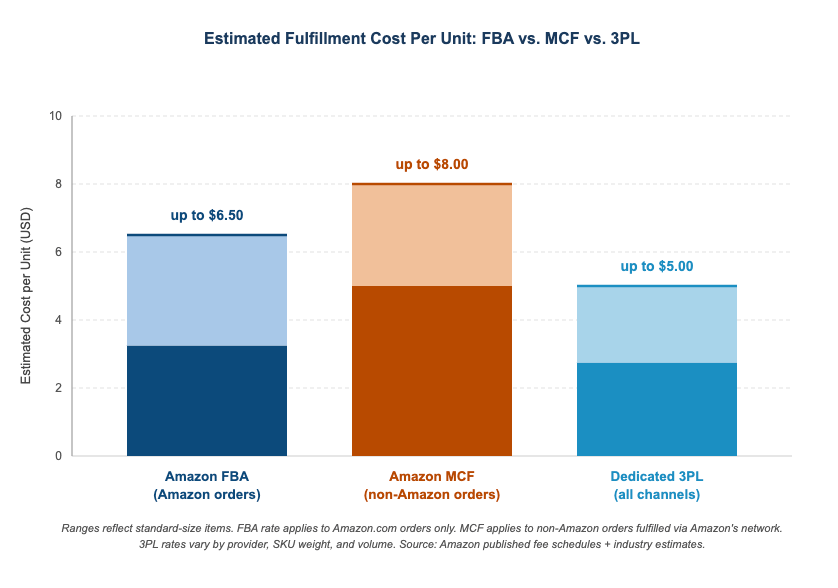
MCF is convenient, but it comes at a price. Amazon MCF fees are higher per unit than FBA, and they're notably higher than what most quality 3PLs charge for equivalent fulfillment. For a standard-size item under 1 lb, expect to pay roughly $5–$7 per unit through MCF, compared to $3–$5 through a dedicated third-party fulfillment provider.
There are two other friction points worth knowing:
1. No custom branding. MCF orders ship in Amazon-branded boxes. For brands investing in the unboxing experience — inserts, custom packaging, tissue paper — this is a real limitation. You're essentially advertising Amazon to your own customers.
2. Restricted products. Amazon MCF won't fulfill certain product categories (lithium batteries, hazardous materials, items over 150 lbs). If you sell anything in those categories, you need a backup fulfillment solution anyway.
When FBA Makes Sense
FBA is the right call when:
- Amazon is your primary or dominant channel. If 70%+ of your revenue comes from Amazon.com, FBA's Prime badge and Amazon-native logistics are hard to beat.
- You're early stage and want simplicity. FBA offloads the logistics burden entirely. For a brand just starting out, that operational simplicity has real value.
- You're running high-velocity SKUs. FBA's fulfillment speed and Prime placement are significant conversion advantages on Amazon's own platform.
When MCF (or a 3PL) Makes More Sense
MCF starts to make sense when you're selling across multiple channels but want a single inventory pool. But as volume scales, the math often tips in favor of a dedicated third-party logistics provider instead.
Use MCF when:
- You're primarily an FBA seller and want to extend fulfillment to a small DTC or secondary channel without managing a separate 3PL relationship
- Your non-Amazon order volume is low enough that the per-unit premium doesn't add up to much
Consider a dedicated 3PL when:
- Your DTC or multi-channel volume has grown to the point where MCF fees become material
- You want custom packaging and branded unboxing
- You need flexibility in how you handle returns, bundles, or special packaging (kitting, inserts)
- You want a fulfillment partner that can grow with you across every channel — not just Amazon's
The Case for a Unified Fulfillment Partner
The brands that scale most efficiently aren't running FBA for Amazon and patching together MCF for everything else. They're working with a fulfillment partner that handles the full picture: a 3PL that integrates with Amazon and every other channel, with a single inventory view, consistent SLAs, and the flexibility to customize the fulfillment experience by channel.
That's the model Cart.com is built around. Cart brings deep Amazon expertise, including FBA strategy, listing optimization, and strategic advertising, alongside fulfillment operations built for multi-channel brands. And beyond fulfillment, Cart's Commerce Services team works alongside brands to drive growth across every layer of the business: marketplace management, performance marketing, branded customer support, and store optimization.
Whether you're evaluating how to split inventory between FBA and a 3PL, or looking to move off MCF entirely, the team has seen every configuration and can help you model the cost and operational tradeoffs, then build the demand engine to make the most of whatever fulfillment setup you land on.
Bottom Line
Amazon FBA is the best tool for Amazon-native sales. Amazon MCF is a workable bridge solution for brands extending to other channels. But for brands serious about multi-channel growth — especially those with meaningful DTC volume — a dedicated 3PL with Amazon integration is typically the right long-term infrastructure.
The fees are lower, the branding is yours, and the flexibility is significantly greater.
Ready to see what your fulfillment costs actually look like across channels? Talk to Cart.com's team — we'll walk you through a cost comparison built around your SKU mix and channel breakdown.
Related reading: