


Table of Contents
Fashion ecommerce return rates averaging 20-30% industry-wide create significant operational and financial challenges that require specialized fulfillment approaches beyond traditional return processing methods. These elevated return rates cost the fashion industry billions annually, while testing the limits of standard logistics operations.
Understanding fashion return patterns helps brands make informed decisions about fulfillment strategies, inventory management and customer experience optimization. This comprehensive analysis examines return rate variations across fashion categories and price points, plus proven strategies for managing this complex challenge.
Fashion ecommerce return rates by category and price point |
|||||
|---|---|---|---|---|---|
|
Fashion category |
Average return rate |
High-end (>$200) |
Mid-range ($50-$200) |
Budget (<$50) |
Primary return reasons |
|
Women's apparel |
24-26% |
15-20% |
22-24% |
28-32% |
Fit, style, fabric quality |
|
Men's apparel |
18-22% |
12-16% |
18-20% |
24-28% |
Sizing, comfort, style |
|
Footwear |
17-35% |
10-15% |
20-25% |
30-40% |
Comfort, fit, style mismatch |
|
Cosmetics |
10-15% |
8-12% |
12-16% |
18-22% |
Color mismatch, allergies |
|
Accessories |
12% |
6-10% |
10-14% |
15-18% |
Quality, size, style |
|
Activewear |
20-25% |
15-18% |
20-22% |
25-30% |
Fit, performance, comfort |
|
Formal wear |
25-30% |
18-22% |
24-28% |
32-38% |
Fit, occasion mismatch |
Fashion return rates demonstrate clear patterns across categories and price segments:
- Women's apparel, for example, consistently exceeds men's clothing returns due to broader style variations and fit complexity.
- Footwear shows the widest return rate range, reflecting comfort sensitivity and sizing inconsistencies across brands.
- Price point correlation proves significant across all categories, with high-end fashion items benefiting from more deliberate purchase decisions and superior materials, resulting in lower return rates compared to their budget counterparts.
Regardless of the sub-segment or price point, however, retailers and ecommerce brands benefit greatly from reducing return rates as much as possible. The following sections detail several strategies to reduce fashion ecommerce return rates as well as the best means to implement them.
Return rate reduction strategies
Return reduction strategies must address the complete customer journey, from product discovery through post-purchase experience. The most effective approaches combine preventive measures with processing efficiency improvements based on industry best practices and proven methodologies.
Product presentation optimization
Accurate product representation remains the foundation of return reduction in fashion ecommerce. Brands investing in comprehensive visual and descriptive content see measurable improvements in customer satisfaction and return rates.
Standardized product photography protocols
Consistent lighting, multiple angles, on-model and flat lay shots create realistic customer expectations when purchasing products. This means implementing professional photography standards for your products; controlled environments with standardized lighting setups, color-accurate monitors and detailed shot lists covering front, back, side and detail views.
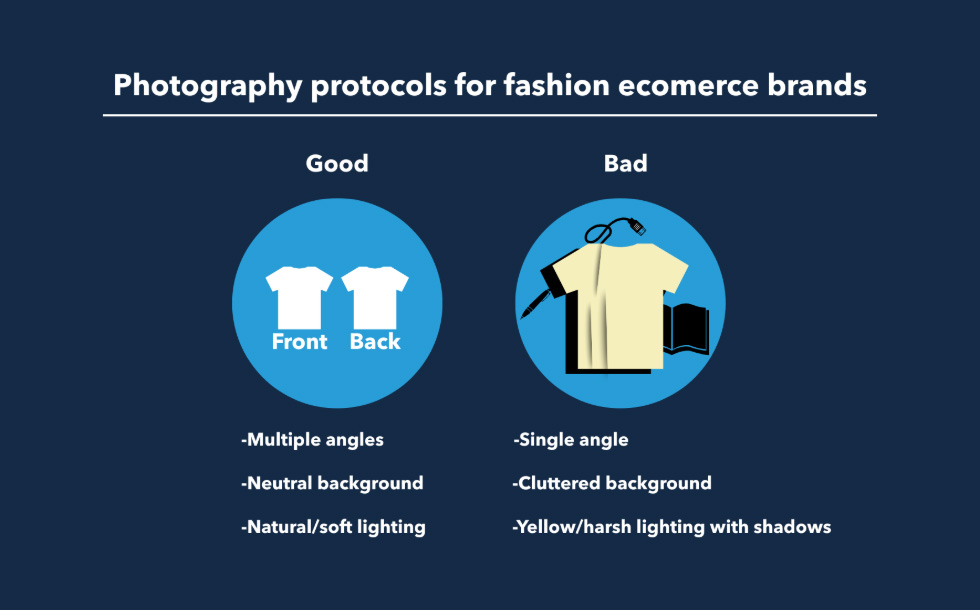
To this end, on-model photography must represent diverse body types and sizes to help customers visualize their fit accurately. Flat-lay shots provide scale reference and construction details not visible in lifestyle photography. Detail shots highlighting fabric texture, construction quality and hardware close-ups reduce uncertainty about product quality.
Detailed size charts with measurement guidance
Comprehensive size charts reduce fit-related returns by providing clear measurement instructions and size recommendations. Effective size charts include body measurements, garment measurements and fit guidance for different body types.
Size chart quality comparison |
|
|---|---|
|
Good |
Bad |
|
|
|
|
|
|
|
|
|
|
|
|
These optimizations require regular updates based on a) return feedback and b) construction changes, such as the use of new materials or processes in manufacturing that might affect the overall fit. To that effect, interactive size guides that recommend sizes based on customer measurements or comparable garment fits prove more effective than static charts.
Fabric composition and care instruction clarity
Transparent fabric information helps customers make informed decisions about comfort, care requirements and durability expectations. Detailed fabric descriptions should include:
- Fiber content: Identify the exact composition (e.g., 100% cotton, 60% polyester / 40% viscose). This helps buyers understand softness, breathability and sustainability.
- Weight: Identify the exact composition (e.g., 100% cotton, 60% polyester / 40% viscose). This helps buyers understand softness, breathability and sustainability.
- Stretch characteristics: Note if the fabric has no stretch, slight give or high elasticity (e.g., 5% elastane). This informs comfort and fit expectations.
- Care instructions: Provide clear, simple directions such as “machine wash cold, tumble dry low” or “dry clean only.” Mention if the fabric is prone to shrinkage, wrinkles or special handling.
Care instruction clarity prevents returns due to maintenance concerns. Customers appreciate upfront information about special care requirements, shrinkage potential and color fastness before purchase decisions.
Customer review integration showing real-world fit feedback
Authentic customer reviews providing fit feedback significantly influence purchase decisions and return rates. Review systems encouraging specific feedback about sizing, quality and style help future customers make accurate choices.
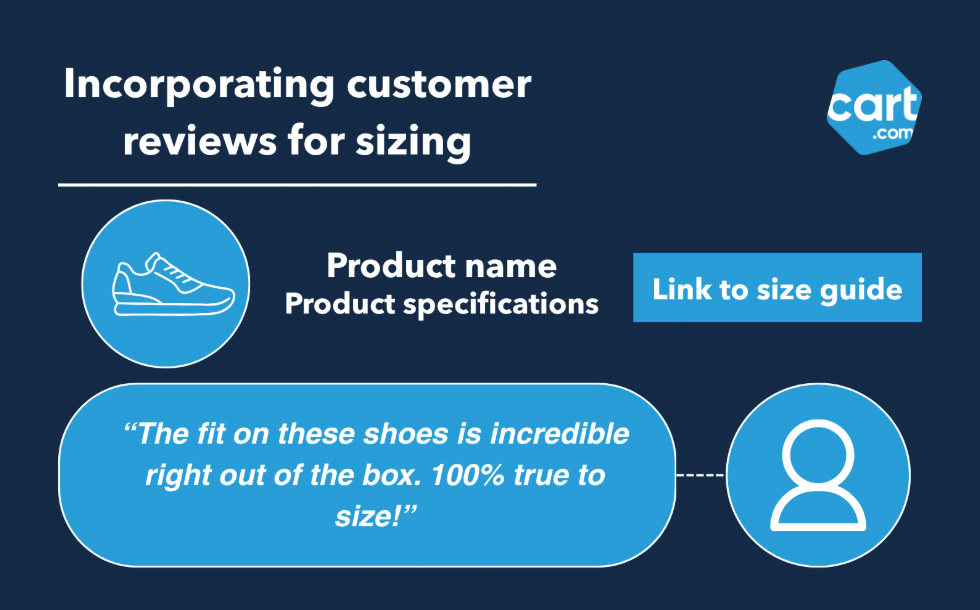
Photo reviews showing real customers wearing products provide additional fit reference points beyond professional photography. Brands successfully using customer photo integration see 15-20% lower return rates on reviewed products.
Quality control and vendor management
Systematic quality control processes prevent returns caused by manufacturing defects, poor construction or materials that don't match specifications. Consistent vendor management ensures that product quality standards are maintained across all suppliers.
Quality assurance frameworks |
||
|---|---|---|
|
Control point |
Inspection criteria |
Rejection thresholds |
|
Incoming materials |
Color accuracy, weight, stretch |
>2% variance from specs |
|
Pre-production samples |
Construction, fit, finishing |
Any spec deviation |
|
Production monitoring |
Stitch quality, measurements |
>3% defect rate |
|
Final inspection |
Overall quality, packaging |
>1% critical defects |
Quality control investments reduce returns while building brand reputation for consistency and reliability. Proactive quality management costs significantly less than processing returns and managing customer dissatisfaction.
Implementing ecommerce fashion return strategies
Fashion brands have three primary options for managing return operations:
- Third-party logistics partnerships: 3PL partnerships offer scalability and specialized expertise without capital investment requirements. High-quality 3PLs like Cart.com bring advanced technology, nationwide distribution networks and return processing specialization that most brands cannot develop internally. These partnerships provide access to sophisticated inventory management systems, automated routing capabilities and integrated customer service platforms.
- In-house processing: In-house return processing provides maximum control over customer experience and product handling. Brands maintain direct oversight of return inspection, restocking decisions and customer communication throughout the process. However, in-house operations require significant investments in warehouse space, labor, technology systems and reverse logistics expertise.
- Hybrid approaches: Hybrid approaches combine selective in-house processing for high-value or complex returns with 3PL partnerships for standard volume processing. This strategy allows brands to maintain control over critical touchpoints while leveraging 3PL efficiency for routine operations.
Each option presents distinct advantages and limitations based on business size, volume and operational complexity. However, 3PLs tend to be the most productive and cost-effective options for businesses handling even moderately high (~1000 orders per month) volume.
Managing fashion ecommerce return rates with Cart.com
Optimizing fashion ecommerce return rates requires specialized 3PL fulfillment approaches that balance operational efficiency with customer satisfaction. Cart.com's nationwide network and advanced technology help fashion brands reduce return processing costs while maintaining service quality.
If you are interested in learning about how working with a high-level 3PL can elevate your fashion ecommerce return rates, speak with a representative for more information here.