


What does it take to build a brand that makes people want to pick up a sport they've never played? Ask Eastside Golf, and the answer starts not with a golf club — but with a closet.
Founded by Morehouse College golf alumni Elijah Janaku and Earl Cooper, Eastside Golf was built on a deceptively simple premise: golf clothing should be something you actually want to wear. That mission, rooted in inclusivity and authentic style, has turned Eastside into one of the most culturally relevant brands in the sport. Nike collaborations. Jordan brand footwear. Limited drops that drive serious traffic. A customer base that stretches far beyond the fairway.
But building a brand is one thing. Scaling the commerce infrastructure behind it, without losing what makes it special, is another. That's where Cart.com comes in.
In a recent webinar hosted by Cart.com CMO Jack Ulrich, Eastside Golf President and COO Chris Nakatani and Cart.com Chief Delivery Officer Chris Mehrabi sat down to talk about what that partnership actually looks like in practice. Here are the key takeaways.
The Origin Story: Constraint as a Creative Catalyst
Eastside Golf didn't start as a business plan. It started with a problem. Elijah Janaku, a nationally-ranked golfer who won a championship at Morehouse College, couldn't find a sponsor as he pursued a professional career. So he created one. He built the brand to sponsor himself, and in doing so, accidentally built something much bigger.
"It's a great message in terms of perseverance for a dream," said Nakatani during the webinar. That spirit of betting on yourself runs through everything Eastside does.
The founders' dual identity as athletes and style-conscious consumers shaped the brand's core tension: golf is one of the most exclusive sports in the world, with strict dress codes and high barriers to entry. Eastside Golf's answer wasn't to ignore those rules, it was to work within them while making the game feel genuinely welcoming to anyone who wanted to play.
The result is a brand that doesn't lead with golf. It leads with fashion. Golf comes along for the ride.
Fashion + Sport: The Design Philosophy That Drives Everything
One of the most telling details from the webinar was about pants. Specifically, elastic-waist pants with belt loops.
"We may put an elastic waist pant and put belt loops on that elastic waist pant so that she could wear it casually, comfortable with elastic waist, or put a belt on it, because you're going to a private club and that's necessary for the rules of the sport," Nakatani explained.
It's a small detail, but it captures everything about the Eastside Golf philosophy: meet the customer where they are, whether that's a municipal course or a members-only club. Versatility is built into the product itself.
That same thinking extends to their Nike and Jordan Brand collaborations — most famously, Air Max shoes with a swappable swoosh, allowing wearers to customize the colorway to match their outfit. The Swingman logo, an artist's rendering of founder Elijah, appears on collaborations as a nod to the brand's roots and its mission to expand access to the game.
"There are a lot of people that wear polo shirts that have never picked up a polo mallet," Nakatani noted with a smile. The point: apparel can be a gateway. Style can be an invitation.
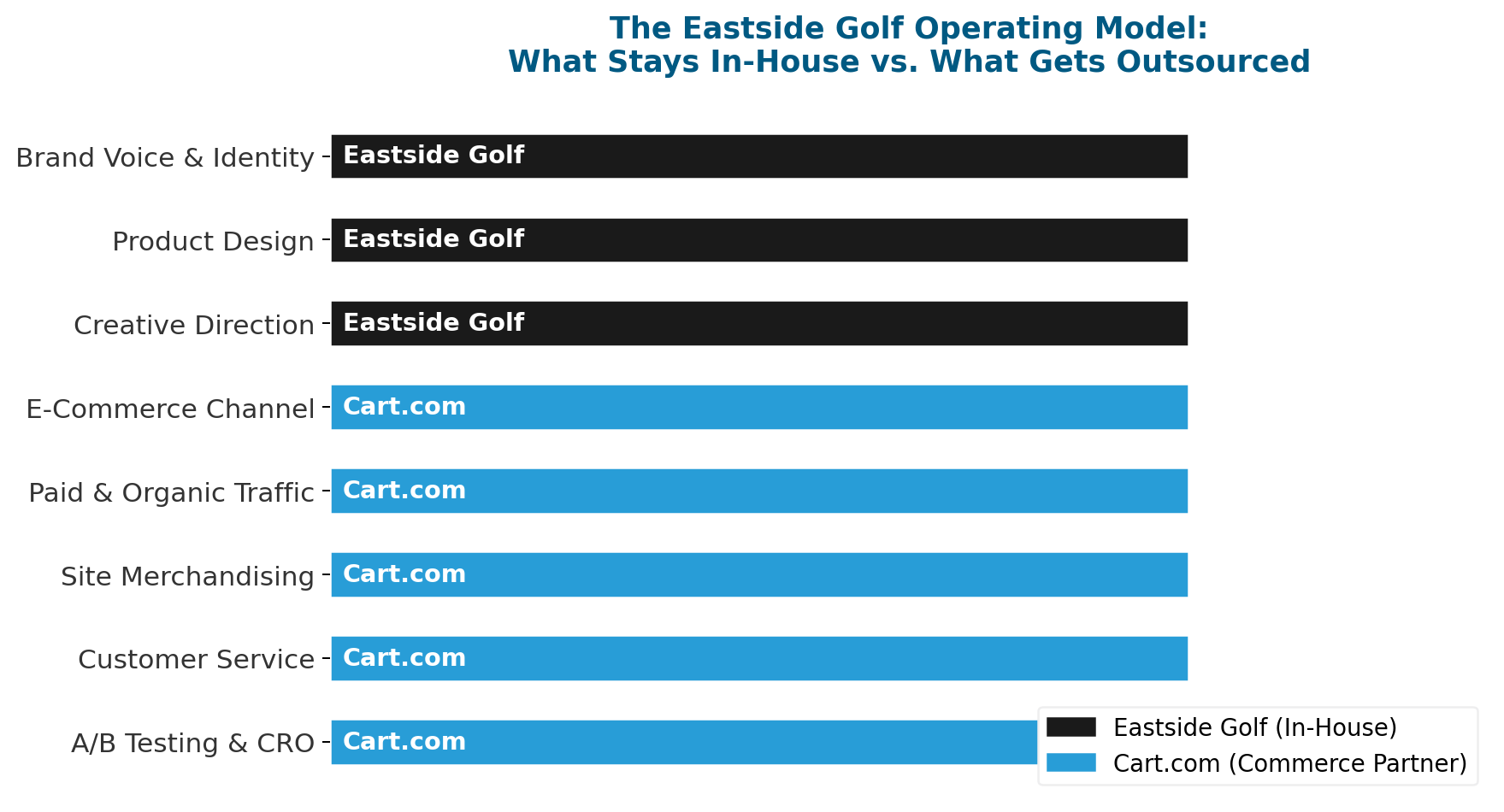 Eastside Golf's operating model: brand and creative stays in-house; e-commerce execution is handled by Cart.com.
Scaling the Commerce Side Without Slowing Down the Creative Side
When a brand moves at Eastside Golf's pace, constant drops, limited-edition collabs, new product lines, the commerce infrastructure behind it has to keep up. A bottleneck on the operational side can kill the momentum a creative team works hard to build.
That's the core challenge Cart.com was brought in to solve. As Mehrabi explained, Cart.com manages the full e-commerce channel on behalf of Eastside Golf: driving traffic, building and optimizing the site, converting visitors into customers, and servicing those customers after purchase.
"Every business has a different cadence," Mehrabi said. "There's no one-size-fits-all solution. You have to have the right solution for that specific business, and that's what we build in conjunction with our partners."
For Eastside Golf, that meant building a planning cadence aligned with their 9-month production cycle — ensuring that Cart.com's e-commerce team is always in sync with what's launching, when it's launching, and what story the brand is trying to tell around it.
"The promotion that is around it, whether it is a branded message or a sale that we're preparing for 4th of July, becomes critically important," said Nakatani. "They need to be in step with us to communicate and make sure that the website experience is the same that we're trying to show at our wholesale distribution."
That omnichannel consistency, from eastsidegolf.com to Nordstrom to Dick's Sporting Goods to Golf Galaxy, is only possible when the e-commerce partner is truly embedded in the brand's strategy, not just executing tasks.
A/B Testing as the Tie-Breaker
One of the most concrete growth levers to come out of this partnership: a robust A/B testing program focused on product-driven click rate optimization and visual merchandising.
"Whenever you're partnering with somebody, there's always going to be lots of hypotheses and different opinions around what's going to work," said Mehrabi. "What we found is the best way to solve those questions is with a robust A/B testing plan that allows us to answer those hypotheses as opposed to just debating them."
This kind of data-driven approach is a hallmark of Cart.com's commerce services model — turning gut-feel debates into testable experiments and letting the data determine the path forward. For a brand like Eastside Golf, where every product drop is a moment, getting the on-site experience right matters enormously.
The Partnership Principle: One Team, One Mission
Perhaps the most memorable line from the entire webinar came from Nakatani, unprompted: "Candidly, our approach is — it's not Cart, it's Eastside Golf. It's one team. We get out of it what we put into it."
That philosophy drives how the relationship actually works day-to-day. And it starts, according to Mehrabi, with a process of genuine immersion. Before Cart.com's team touched a single campaign or site optimization for Eastside Golf, they spent a week in Eastside's offices — feeling the product, living the brand.
"This is a touch and feel business," said Nakatani. "You have to feel the product, live the product, live the brand, and immerse yourself in the culture of the company, because the brand message is so important."
That's the foundation. And according to Mehrabi, without it, everything else falls apart.
"The biggest watch out, honestly, is communication and clarity," he said. "Clarity of mission, clarity of targets, clarity of priorities. There are a lot of businesses out there that don't have that, that maybe don't know what they want to be when they grow up. Forcing those conversations up front, making sure that there is a clear direction, a clear set of goals, a clear set of accountability, that's key to making the relationship work."
The Key Lesson for Fast-Growing Brands
If there's one takeaway for brand operators at an inflection point, infrastructure straining, growth accelerating, operational complexity compounding, Nakatani's advice cuts through the noise:
"Don't be afraid of outsourcing. Don't outsource your brand, don't outsource your design. But allow pros to come in and support you. They've been in the business for much longer than we have. They're experts at the business."
The consumer, as he put it, doesn't give you a break. They expect the same seamless experience they'd get on Amazon — fast checkout, reliable delivery, responsive service. Building that infrastructure in-house, while simultaneously trying to design product, tell stories, and build a culture? For most brands, it's the wrong bet.
What Eastside Golf has figured out is the cleaner version: own what makes you irreplaceable, and partner for the rest. Cart.com's commerce services model is built exactly for that kind of relationship — where the brand stays the brand, and operations become a strategic advantage rather than a constraint.
Watch the Full Webinar
Want to hear the full conversation? Check it out here.
To learn more about how Cart.com partners with brands like Eastside Golf to scale e-commerce operations, reach out to our team.