

Table of Contents
Walmart Marketplace is no longer an afterthought for brands that take Amazon seriously. With 120M+ monthly visitors and a seller ecosystem that's still less saturated than Amazon in most categories, it's become one of the most compelling expansion channels for DTC brands ready to move beyond their primary platform.
This guide covers everything you need to know to get started — from the approval process through fulfillment, advertising, and how to actually compete and win.
Why Walmart Marketplace Is Worth Your Attention
The case for Walmart Marketplace comes down to three things: audience reach, lower competition, and improving economics.
Audience reach: Walmart.com attracts over 120 million unique monthly visitors. That's the second-largest marketplace audience in the U.S. by traffic. More importantly, the Walmart customer skews differently from Amazon — more value-conscious, more suburban, and heavily represented in household staples, health, and home categories. For many brands, this is an incremental, not overlapping, audience.
Lower competition: Amazon has been saturated in most categories for years. Walmart is still catching up, which means organic ranking is more achievable, sponsored listing CPCs are lower, and new entrants can gain visibility without the same level of paid investment.
Economics: Walmart charges no monthly seller fee (Amazon charges $39.99/month). Referral fees are similar to Amazon (6–15% depending on category), but the lower advertising costs and better organic visibility can meaningfully improve the overall unit economics of a Walmart sale vs. an equivalent Amazon sale.
Walmart Marketplace vs. Amazon: Fee Comparison
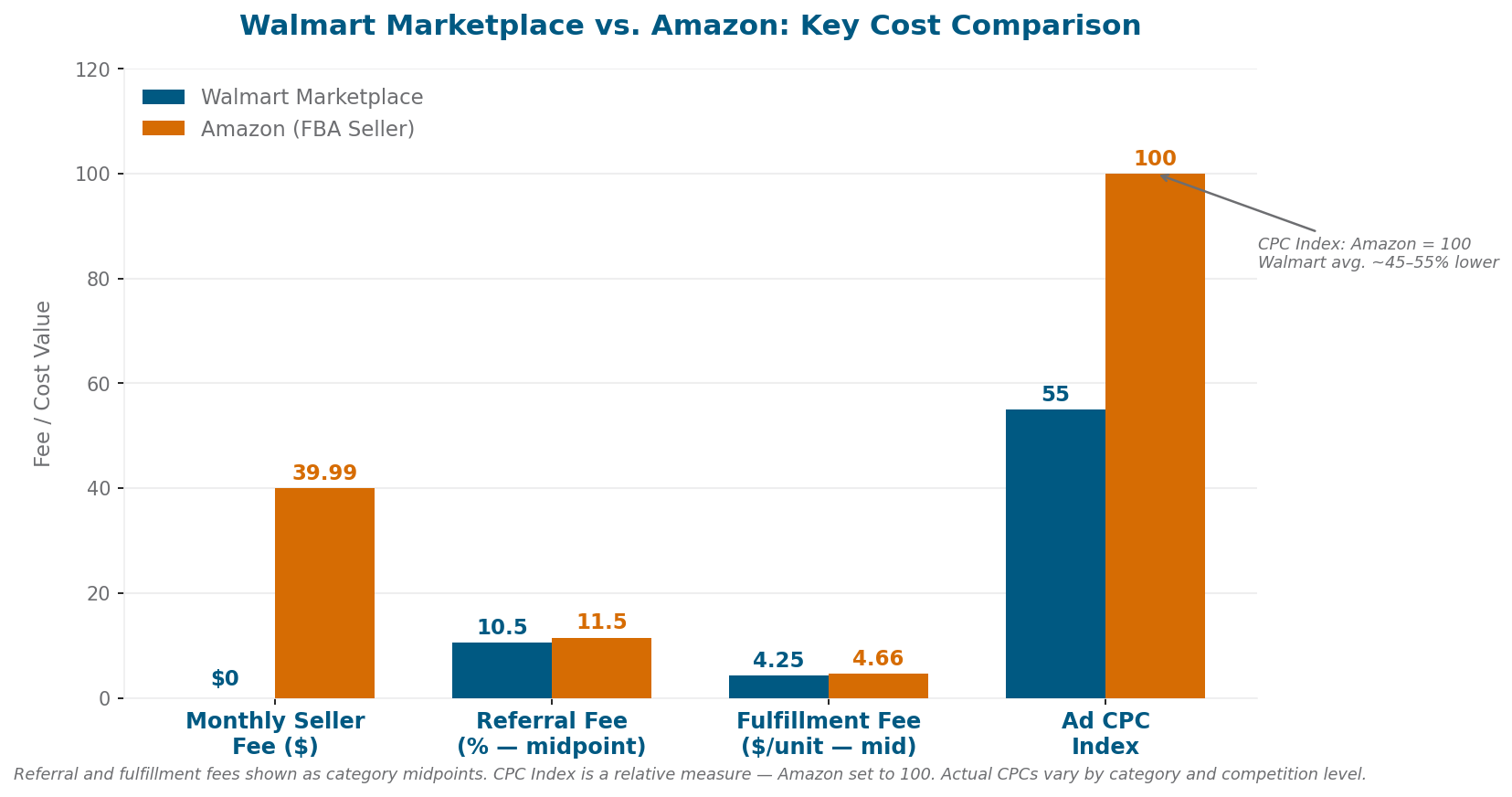
| Walmart Marketplace | Amazon (FBA Seller) | |
|---|---|---|
| Monthly seller fee | $0 | $39.99 |
| Referral fee | 6–15% | 8–15% |
| Fulfillment fee (standard item) | WFS: ~$3.45–$5.00 | FBA: ~$3.22–$6.10+ |
| Avg. CPC (sponsored listings) | Lower | Higher |
| Organic competition | Moderate | High |
Step 1: Apply for Walmart Marketplace Approval
Unlike Amazon, Walmart Marketplace is a selective, application-based platform. Not every seller gets approved, and the process can take 2–4 weeks.
What Walmart looks for:
- U.S. business with a verified EIN and W-9
- Established brand with a real website — Walmart vets your brand presence before approving
- Quality product catalog — low-quality, unsafe, or heavily duplicated products are rejected
- Competitive pricing — Walmart enforces price parity; your prices on Walmart can't be higher than on Amazon or your own site
- Clean fulfillment track record — if you have existing marketplace metrics, they'll be reviewed
Where to apply:
Go to marketplace.walmart.com and click "Request to Sell." You'll fill out a multi-step application covering your business profile, product catalog overview, and fulfillment capabilities.
Tip: A polished website, a clean Amazon seller account (if applicable), and a catalog with at least 10–20 strong products significantly improve approval odds. Prepare your product information and brand story before you start the application — it matters.
Step 2: Set Up Your Seller Account
Once approved, you'll set up your Seller Center account — Walmart's equivalent of Amazon Seller Central. Key setup steps include:
- Tax and banking setup: Connect your business bank account and complete tax documentation through Payoneer or direct deposit.
- Shipping templates: Define your shipping methods, carrier options, and delivery windows. Walmart places significant weight on shipping speed — two-day delivery eligibility improves your listing rank.
- Return policy configuration: Walmart requires a minimum 30-day return window. You can set up returns to go to your own warehouse or use Walmart's return centers.
- Brand profile: Set up your seller profile with your brand logo, description, and contact information. A complete profile builds buyer trust.
Step 3: Build Your Product Listings
Walmart listing optimization follows similar principles to Amazon but with a few platform-specific nuances.
Listing components that matter:
Title: Follow Walmart's title format guidelines — typically [Brand] + [Product Name] + [Key Attribute] + [Size/Count]. Keep it clean and keyword-rich without keyword stuffing.
Images: Walmart requires a white-background main image at 2000x2000 pixels minimum. Additional lifestyle and detail images improve conversion. Walmart supports up to 10 images per listing.
Attributes and specifications: Walmart's search algorithm relies heavily on product attributes for categorization and ranking. Fill out every relevant attribute, not just the required ones. Incomplete attributes hurt your discoverability.
Description and rich content: Use Walmart's Rich Media Content (equivalent to Amazon A+ Content) if it's available for your category. Enhanced content with lifestyle images, feature callouts, and comparison modules measurably improves conversion.
Price: Remember price parity. Walmart's system regularly scans competitor pricing, including Amazon and your own website. If your Walmart price is higher, your listing can be suppressed from the Buy Box.
Step 4: Choose Your Fulfillment Model
You have two primary options for fulfilling Walmart orders:
Walmart Fulfillment Services (WFS)
WFS is Walmart's first-party logistics network, similar to Amazon FBA. You ship inventory to Walmart's fulfillment centers; Walmart handles pick, pack, and ship for all Walmart.com orders. WFS-fulfilled items are eligible for Walmart's two-day delivery badge, which is the single biggest driver of Buy Box placement and organic ranking.
WFS fees: Roughly $3.45–$5.00 per unit for standard items, plus monthly storage fees. The fee structure is competitive with Amazon FBA and often lower for heavier items.
Use WFS if: You want the two-day badge, you're new to Walmart and want the operational simplicity, or you don't have existing 3PL infrastructure capable of meeting Walmart's SLAs.
Seller-Fulfilled (with a 3PL)
You can also fulfill Walmart orders through your own warehouse or a third-party logistics provider. To be competitive, you need to be able to reliably offer two-day delivery — which means either having a strong warehouse network or working with a 3PL that has the geographic footprint to meet those windows.
Use seller-fulfilled if: You already have a 3PL relationship that delivers reliably in 1–2 days, you want more control over the fulfillment experience, or you need the flexibility to handle custom packaging, kitting, or branded inserts.
Cart.com's fulfillment network supports both Walmart Fulfillment Services integration and direct seller-fulfilled Walmart orders, with the inventory routing and SLA management built in.
Step 5: Advertise on Walmart
Walmart Connect (Walmart's ad platform) has matured significantly over the past two years. It's still less sophisticated than Amazon Advertising, but for many brands, that's an advantage — the competition for ad placement is lower and CPCs are meaningfully cheaper.
Walmart ad types to know:
Sponsored Products: The core ad format — keyword-targeted listings that appear in search results and product pages. Start here.
Sponsored Brands: Brand-level ads that appear at the top of search results with your logo and a custom headline. Good for brand building once your core sponsored product campaigns are established.
Display Ads: Programmatic display through Walmart's DSP, which can reach Walmart shoppers on Walmart.com and across the web. Relevant for larger budgets and brands thinking about full-funnel Walmart strategy.
Getting started:
For most new Walmart sellers, a basic Sponsored Products campaign targeting your primary keywords is the right starting point. Set a conservative daily budget, monitor your ACoS (advertising cost of sale) weekly, and scale what's working. Don't launch without advertising — organic rank for new listings is almost always too low to drive volume without some paid support.
Step 6: Manage Performance and Stay Compliant
Walmart monitors seller performance aggressively. There are three metrics that directly affect your account health and listing visibility:
| Metric | Walmart Threshold | Why It Matters |
|---|---|---|
| On-time delivery rate | ≥ 95% | Poor delivery = listing suppression |
| Order defect rate (ODR) | ≤ 2% | High ODR can get your account suspended |
| Valid tracking rate | ≥ 95% | Required for seller-fulfilled orders |
Stay on top of these from Day 1. A new Walmart account with poor metrics will struggle to recover, and there's less tolerance for a rough launch than you might be used to from other platforms.
Common Mistakes New Walmart Sellers Make
Treating Walmart like a copy-paste from Amazon. The platforms have different algorithms, different buyer behaviors, and different listing requirements. Listings that work on Amazon need to be adapted — not just cloned.
Skipping the two-day delivery setup. Two-day shipping eligibility is so central to Walmart's ranking algorithm that launching without it puts you at a structural disadvantage. Either enroll in WFS or confirm your 3PL can hit the window before you go live.
Pricing inconsistently. Walmart's price parity enforcement is real and automated. Brands that run promotions on Amazon without adjusting Walmart pricing find their listings suppressed — sometimes without a clear warning.
Under-investing in advertising at launch. New listings have no organic history. Without some advertising support, you simply won't be visible. Budget for a launch spend period of 60–90 days to build rank.
Is Walmart Marketplace Right for Your Brand?
Walmart Marketplace is a strong fit for:
- Brands already on Amazon looking to expand with minimal new operational complexity
- Products in household, personal care, health, home, and pet categories
- Brands with healthy enough margins to absorb a second marketplace fee structure
- Sellers who can meet Walmart's two-day delivery requirements (via WFS or a capable 3PL)
It's less ideal for:
- Premium or luxury brands where the Walmart association creates positioning friction
- Very early-stage brands without established fulfillment infrastructure
- Niche categories with minimal Walmart search volume
Getting Started
The Walmart Marketplace opportunity is real — but executing well requires the right setup from the start. Brands that launch with optimized listings, two-day fulfillment, and a basic advertising strategy in place outperform those who treat it as an afterthought.
Cart.com's marketplace management team helps brands launch and scale on Walmart — from approval and setup through listing optimization, WFS onboarding, and ongoing campaign management. If you're considering adding Walmart to your channel mix, reach out to our team and we can assess your catalog fit and build a launch plan.
Related reading: