


Table of Contents
Over the past several months, I've had the opportunity to help lead our AI Transformation Program at Cart.com.
Like many organizations, we started with an important question: Where can AI create measurable business value?
What I quickly learned is that building enterprise AI has very little to do with creating another chatbot. It's about improving the decisions people make every day.
Our first wave focuses on three AI agents, each solving a different business problem:
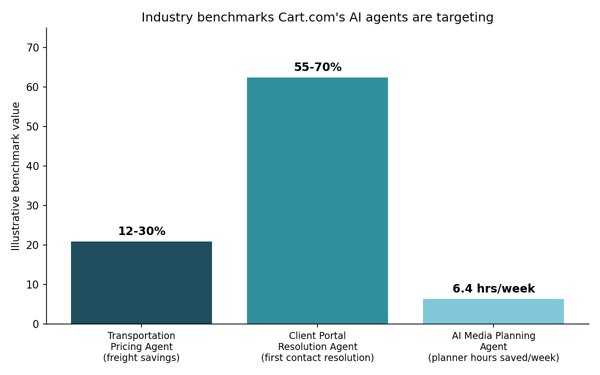
- Transportation Pricing Agent – helping teams make faster, more informed freight pricing decisions. Automated, cost-optimized carrier rating and margin management with explainability, replacing manual laborious rate-shopping. Industry benchmarks show automated multi-carrier rate shopping can return ~15% in freight cost savings — the kind of margin impact we're targeting.
- Client Portal Resolution Agent – assisting teams in resolving common client requests faster, with less manual effort. Mature AI-native support platforms typically reach 55–70% first-contact resolution within their first year — a bar we're building toward.
- AI Media Planning Agent – transforming data into planning recommendations. Generates scenario-based media plans across channels and SKUs — turning hours of manual planning into minutes. Comparable AI-assisted planning tools free up roughly 6 hours per planner per week — capacity that lets the same team take on more accounts.
At first glance, these look like three separate AI projects. They're not.
They're all being built on a common enterprise platform with shared orchestration, governance, security, evaluation, and reusable AI services. That foundation allows us to scale future AI capabilities without starting from scratch every time.
One lesson has stood out to me throughout this journey:
The hardest part of enterprise AI isn't the model. It's earning trust.
Trust that an AI recommendation is accurate. Trust that sensitive data is protected. Trust that the right guardrails are in place. Trust that a person can step in whenever the business requires it.
That's why we've invested as much time designing governance, human-in-the-loop workflows, evaluation gates, and architecture as we have building the AI agents themselves.
Another realization surprised me: for years, we've talked about digital transformation. AI feels different. Instead of simply automating tasks, AI has the potential to augment how people think, analyze information, and make decisions. That changes how we design systems, define processes, and measure success.
As a program manager, it's also changed how I think about delivery. Success isn't measured by how many AI features we launch. It's measured by whether people trust them enough to use them, and whether they improve business outcomes.
We're still early in this journey, and there's plenty left to learn. But one thing feels clear.
The organizations that succeed with AI won't necessarily be the ones making the biggest announcements. They'll be the ones quietly embedding AI into everyday operations, solving real business problems, and delivering measurable value over time.
I'm excited to be part of that journey, and even more excited to see where it leads.