
Table of Contents
Selling on every marketplace isn't a strategy — it's a distraction. The brands that win on marketplaces in 2026 are the ones who choose the right two or three platforms, optimize hard, and treat each one as a distinct channel with its own playbook.
So which marketplaces are actually worth it? That depends on your category, your margins, and where your customers are already shopping. Here's what you need to know about the major platforms, and how to think about where to place your bets.
The Marketplace Landscape in 2026
The U.S. marketplace landscape has consolidated around a handful of dominant players, with a few fast movers eating into niche categories. Amazon remains the default starting point, but Walmart Marketplace has made real gains, TikTok Shop is reshaping how discovery-driven products get sold, and platforms like Target Plus and Faire are opening meaningful doors for the right brand profiles.
Monthly Active Shoppers by Platform (U.S. Estimates, 2026)
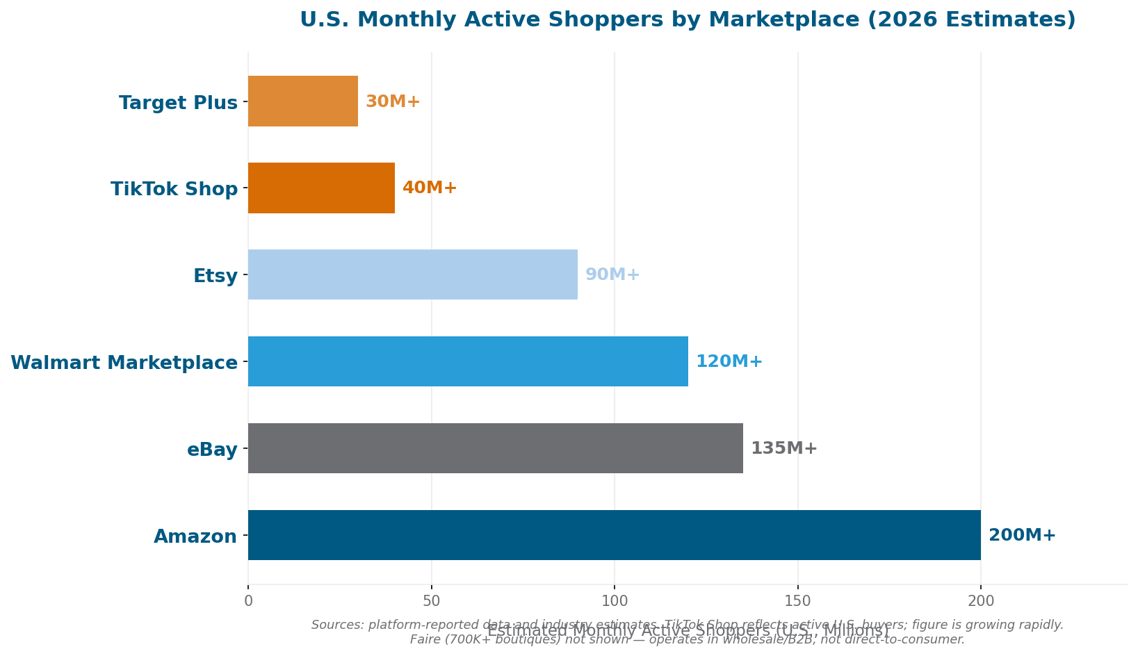
| Marketplace | Est. Monthly Active Shoppers | Best For |
|---|---|---|
| Amazon | 200M+ | Nearly every category |
| Walmart Marketplace | 120M+ | Value-conscious shoppers, household staples |
| eBay | 135M | Collectibles, refurb, unique/vintage |
| Target Plus | 30M+ | Premium CPG, home, lifestyle |
| TikTok Shop | 40M+ (growing fast) | Discovery-driven, trend-forward products |
| Faire | 700K+ boutiques | Wholesale, independent retail |
| Etsy | 90M+ | Handmade, custom, artisan |
Amazon: The Baseline (But Not Always the Best Margin)
If you sell physical goods, you're almost certainly already on Amazon or have considered it seriously. It's the default starting point for most product categories — 63% of U.S. product searches now start on Amazon, not Google.
Strengths:
- Largest addressable audience of any marketplace
- Prime eligibility drives conversion significantly
- Robust advertising infrastructure (Sponsored Products, DSP, etc.)
- Fulfillment through FBA removes logistics complexity for Amazon orders
Challenges:
- Competition is intense across nearly every category
- Amazon takes 8–15% referral fees plus FBA fulfillment costs
- Private label and counterfeit competition on successful listings
- Algorithm changes can significantly affect organic visibility
Best fit: Brands in high-intent categories (supplements, electronics accessories, home goods, beauty) with healthy enough margins to absorb Amazon's fee structure. Not ideal for very low-margin products or highly commoditized categories where you can't differentiate.
Realistic margin math: Before you commit, model your Amazon unit economics including referral fee, FBA fees, advertising spend (typically 10–20% of revenue for competitive categories), and returns. Many brands find their net margin on Amazon is 5–15% — workable, but significantly lower than DTC.
Walmart Marketplace: The #2 Worth Taking Seriously
Walmart Marketplace has grown aggressively and is now the second-largest U.S. marketplace by GMV. What makes it strategically interesting for many brands isn't just the audience size — it's the competition level. Categories that are saturated on Amazon often have significantly less competition on Walmart, which means better organic visibility with less spend.
Strengths:
- 120M+ monthly visitors; strong overlap with Amazon but distinct audience skew (value-focused, Midwest, suburban)
- Lower competition than Amazon in most categories
- Walmart Fulfillment Services (WFS) provides FBA-like logistics for Walmart orders
- No monthly seller fees (Amazon charges $39.99/month)
- Growing advertising platform with less cost-per-click inflation
Challenges:
- Approval process is selective — not every seller gets in
- Category coverage is narrower than Amazon
- WFS logistics footprint is smaller than Amazon's
- Less mature advertising toolset
Best fit: Brands already selling on Amazon who want to expand reach with minimal incremental operational lift. Especially strong for household staples, personal care, and home categories.
TikTok Shop: The Highest-Risk, Highest-Reward Play
TikTok Shop is the most volatile marketplace on this list — regulatory uncertainty, evolving policies, and a platform algorithm that can make or break a product overnight. But for the right brand profile, it's also the fastest path to scale.
The discovery model is fundamentally different from Amazon or Walmart. On TikTok Shop, content drives purchase, not search intent. Products that have strong visual or demonstration appeal — skincare, food, fitness, gadgets — have seen explosive growth through creator-driven content.
Strengths:
- Zero-to-viral potential for demonstrable products
- Affiliate creator network (TikTok Shop Affiliates) lets you scale content without a large team
- Lower CAC for discovery-driven products versus paid social
- Growing Gen Z and Millennial buyer base
Challenges:
- Ongoing regulatory uncertainty in the U.S.
- Returns and customer service can be operationally demanding
- Product categories that don't perform on video won't perform here
- Heavy discounting expectations can compress margin
Best fit: DTC brands with visually compelling products and some capacity to produce or partner on content. Treat it as a discovery channel, not a dependable revenue base — at least until regulatory clarity improves.
Target Plus: Invitation-Only, but Worth Pursuing
Target Plus is a curated, invitation-only marketplace. You can't simply apply — Target's team selects sellers based on brand alignment and category fit. For brands that make the cut, it's an exceptionally high-quality channel: Target's customer skews premium, the competition is limited by design, and Target's omnichannel presence (1,900+ stores) adds a halo effect.
Best fit: Premium CPG, home, baby, apparel, and lifestyle brands with strong retail presence and brand equity. If you're already in conversations with Target's retail buyer team, pursuing Target Plus in parallel makes sense.
Etsy: Niche but Dominant in Its Lane
If your products are handmade, customized, vintage, or artisan — Etsy is non-negotiable. It's the dominant platform in that space with 90M+ active buyers specifically looking for what you're selling. The platform's fee structure (6.5% transaction fee plus listing and payment processing fees) is competitive, and the audience intent is high.
Best fit: Brands or makers in handcrafted goods, personalization, wedding/events, art, and vintage. Not a fit for mass-produced products.
Faire: If You Sell Wholesale
Faire is less well-known outside of wholesale circles, but if you sell to independent retailers, it's where buyers are. Over 700,000 boutiques and independent shops source on Faire, which has become the de facto platform for wholesale discovery. Faire charges brands a commission on new customer orders (15–25%), with a lower rate on repeat orders.
Best fit: Brands with a wholesale component targeting independent retail — gifting, home goods, apparel accessories, artisan food and beverage.
How to Choose: A Decision Framework
Rather than trying to be everywhere, use this framework to prioritize:
1. Start with where your customer already shops. Run a quick survey or analyze your customer data. Are they Amazon-first? Walmart regulars? TikTok native? Go where your buyer already has purchase intent.
2. Model the unit economics first. Each platform has a different fee structure. Build a simple P&L for your top SKUs on each marketplace before you commit to operational setup.
3. Assess your competitive position. Check the competition level in your category on each platform. A marketplace where you're entering a less-crowded field is worth more than a platform with more traffic but brutal competition.
4. Match your fulfillment capacity. More marketplace channels means more inventory management complexity. Make sure your fulfillment infrastructure — whether FBA, a 3PL, or internal — can actually support multi-channel inventory and order routing before you expand.
5. Sequence the rollout. Amazon first, Walmart second, is the right order for most brands. Add a third channel (TikTok Shop, Target Plus, Faire) once you've stabilized operations on the first two.
The Operational Reality of Multi-Marketplace Selling
The brands that struggle with marketplace expansion usually don't fail because they picked the wrong platform — they fail because they tried to manage too many channels with infrastructure built for one. Inventory visibility breaks down, orders get delayed, listings go stale.
The fix is a commerce operations layer that unifies inventory, orders, and fulfillment across channels. Cart.com's marketplace management services handle exactly this: we manage listings, advertising, and operations across Amazon, Walmart, and additional channels — giving brands the reach of a multi-marketplace strategy without the operational overhead of running each one independently. Our marketplace management software gives you a single view across all your channels in real time.
Bottom Line: Best Marketplaces by Brand Profile
| Brand Profile | Recommended Channels |
|---|---|
| Early-stage DTC brand | Amazon → Walmart |
| High-velocity CPG | Amazon + Walmart + TikTok Shop |
| Premium/lifestyle brand | Amazon + Target Plus |
| Artisan/handmade | Etsy → Amazon Handmade |
| Wholesale-focused | Faire + Amazon |
| Discovery-driven (beauty, food, gadgets) | TikTok Shop + Amazon |
The right marketplace mix is different for every brand. But the worst move is spreading thin across too many channels too fast. Pick two, go deep, and expand from a position of operational strength.
Thinking about expanding to a new marketplace? Talk to Cart.com's team — we can assess your catalog, competitive position, and fulfillment setup and build a marketplace launch plan that actually sticks.
Related reading: