AI-powered pick pathing is warehouse software that calculates the most efficient route for a picker to travel through a facility to collect every item on an order, factoring in item location, order composition, and real-time congestion, instead of a fixed or manually-planned route that ignores what's actually happening on the floor at that moment. The mechanics of why this matters are simple: in most warehouses, the biggest cost in order picking isn't the time spent physically grabbing an item off a shelf, it's the time spent walking to get there.
The Problem Pick Pathing Actually Solves
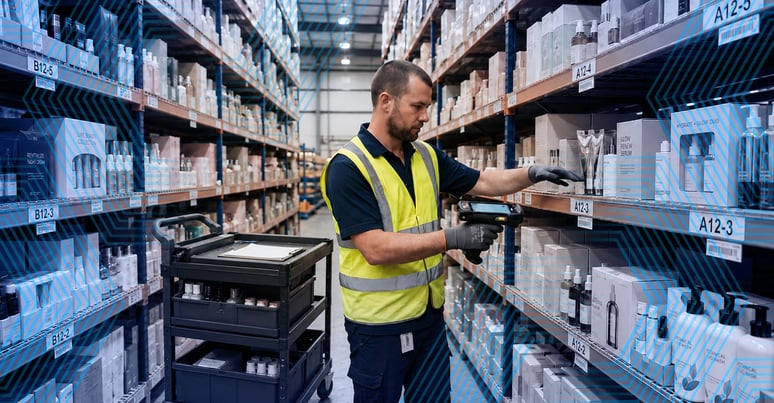
Warehouse labor studies consistently point to the same finding: research cited by Supply Chain 24/7 shows that up to 70 percent of a picker's shift can be spent on travel alone, not picking, packing, or any other value-adding task. That number holds up intuitively once you picture a typical pick path: a picker walking a fixed, poorly sequenced route back and forth across a warehouse floor to fill one order, then repeating a similarly inefficient route for the next one, all day. Every minute spent walking an unnecessary extra aisle is a minute not spent picking, which either means fewer orders shipped per labor hour or more labor hours needed to hit the same shipping target.
Up to 70%
of a warehouse picker's shift can be spent walking rather than picking, per research cited by Supply Chain 24/7.
What AI pick pathing changes
Routes are recalculated per order, in real time, based on item location, order composition, and current floor activity, instead of following a fixed or manually sequenced path.
How AI Pick Pathing Actually Routes a Picker
A fixed pick path assumes the warehouse looks the same every time an order comes through: same congestion, same item locations, same mix of order types moving through the facility. Real warehouses don't work that way. Item locations shift as inventory gets replenished and slotted differently.
Congestion builds up in specific aisles during peak shipping windows. Order composition varies constantly, a single-SKU order and a twelve-item multi-SKU order call for different routing logic even if some of the same items are involved. Cart.com's warehouse management software is built around intelligent algorithms that account for these variables order by order, working alongside the robotic automation systems already deployed across its network, including goods-to-person robotic storage, robotic shuttles and cranes, automated storage and retrieval systems, and automated conveyor and sortation systems.
AI-powered pick pathing is the routing logic that decides how a human picker, or a picker working alongside these automated systems, moves through the building to fill an order in the shortest reasonable path, rather than the path a static route map happened to specify.
Why This Also Reduces Errors, Not Just Time
Pick pathing is usually framed as a speed problem, but the error-rate impact is just as real and often overlooked.
A picker rushing through a long, inefficient route under pressure to hit a shipping cutoff is more likely to grab the wrong item, miss a line on a multi-item order, or misplace inventory when returning to a congested aisle. Shortening and simplifying the actual path reduces the number of decision points and physical handoffs where an error can get introduced, on top of the direct time savings.
That combination, fewer wasted steps and fewer opportunities for a mis-pick, is why pick pathing tends to show up in both throughput metrics and quality metrics at the same time, rather than trading one for the other.
What is pick pathing in a warehouse? Pick pathing is the process of determining the route a warehouse picker travels to collect all the items on an order. AI-powered pick pathing recalculates that route dynamically for each order based on item location, order composition, and real-time warehouse conditions, rather than relying on a fixed or manually planned route.
Frequently Asked Questions
What is AI-powered pick pathing?
AI-powered pick pathing is warehouse software that calculates the most efficient travel route for a picker to fulfill an order, using real-time data on item location, order composition, and warehouse congestion, rather than a static, pre-set route.
Why does pick pathing matter for order accuracy, not just speed?
A long, inefficient pick route increases the number of steps and handoffs where a picker can make a mistake, especially under time pressure near a shipping cutoff. Shortening and simplifying the route reduces both the travel time and the number of opportunities for an error to occur.
How much time do warehouse pickers typically spend walking versus picking?
Industry research cited by Supply Chain 24/7 has found that up to 70 percent of a picker's time in a typical warehouse can go to travel rather than the actual pick, pack, or other value-adding tasks, which is why routing efficiency has an outsized effect on overall labor productivity.
Does AI pick pathing work with warehouse robotics, or replace it?
It works alongside it. In a warehouse using goods-to-person robotics, automated storage and retrieval systems, or robotic shuttles, pick pathing logic still determines the most efficient sequence for the human and automated steps in an order's fulfillment, rather than being replaced by automation entirely.
What causes a warehouse to need dynamic pick pathing instead of a fixed route?
Item locations change as inventory gets replenished and reslotted, order composition varies constantly, and congestion builds up in different areas depending on order volume and timing. A fixed route can't account for any of that, which is why routing needs to be recalculated per order rather than set once.
Can pick pathing improvements be measured directly?
Yes. The clearest indicators are orders picked per labor hour, average pick-path distance per order, and mis-pick or error rates, all of which typically improve together when pick pathing logic accounts for real-time warehouse conditions instead of a static route.
Brands evaluating whether their current 3PL's warehouse technology is actually built for speed and accuracy can see how Cart.com's tech-enabled fulfillment approaches pick pathing and warehouse automation together. Talk to Cart.com about what's slowing down your current pick operation.
Related reading: Behind the Software: Why Cart.com's Reporting and Analytics Go Deeper Than Most Fulfillment Platforms, One Platform, Every Channel: The Case for Unified Commerce Infrastructure Over Point Solutions, What Is Kitting in Fulfillment?